


Marketing strategy and marketing plan are often used interchangeably.
They should not be.
Confusing the two is one of the main reasons marketing feels busy but ineffective. Teams work hard, campaigns go live, content gets published, yet progress feels slow or unclear.
The issue usually sits at the top.
A marketing strategy is not a plan. And a plan is not a strategy.
Strategy is your theory. Your view on how you are going to win in the market. It is the thinking that connects business goals, audience understanding and competitive position.
A plan is how you execute that thinking.
Strategy answers the question: how are we going to win?
A plan answers: what are we doing next?
Where this breaks down is when plans are mistaken for strategy. Detailed calendars. Channel schedules. Campaign timelines. Documents full of activity but very little direction.
Those things are useful. But on their own, they do not tell you why choices were made or how success will be measured.
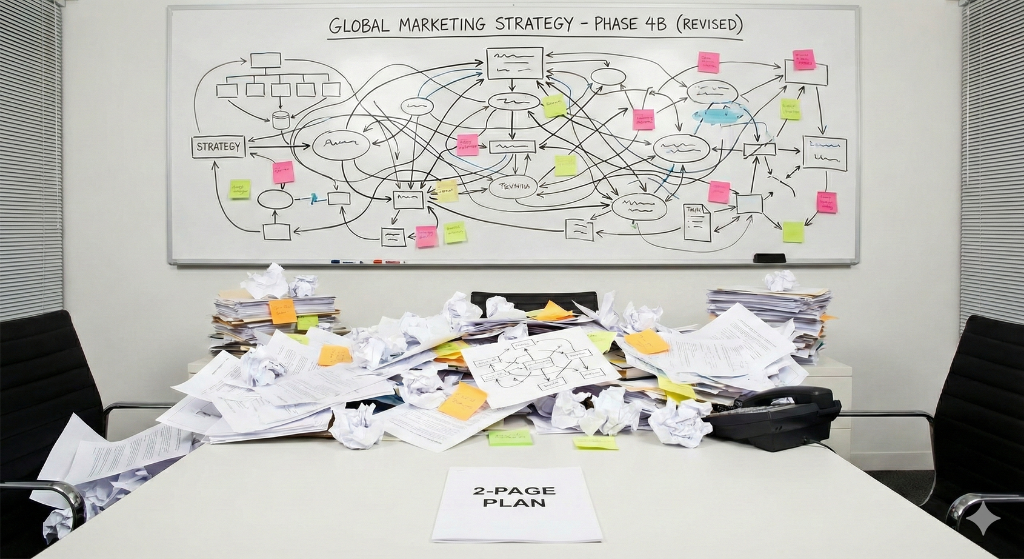
A good marketing strategy does not need to be complicated. In fact, complexity is often a sign that clarity is missing.
Some of the strongest strategies can be explained simply. They set out what the business is trying to achieve, who it is trying to reach, why it should be chosen, and where focus will sit.
They also make something else clear. What will not be done.
That part is often overlooked.
Strategy is as much about saying no as it is about saying yes. If everything is a priority, nothing is. Without clear boundaries, marketing effort gets spread thinly and impact is diluted.
Plans, on the other hand, are meant to change.
They should respond to performance, seasonality, resourcing and opportunity. If a plan is fixed for twelve months regardless of what happens, it is probably not doing its job.
Strategy should move more slowly.
It gives stability when plans change. It provides a reference point when decisions feel unclear. It allows teams to adapt without losing direction.
Another common problem is strategy being treated as a large, formal document. Something dense, detailed and difficult to revisit.
In reality, if a strategy cannot be understood easily, it will not be used.
A strategy should be something a team can refer back to regularly. Something that helps answer questions like:
Does this activity support our goal?
Is this the right audience to focus on?
Are we choosing this channel for the right reason?
If a document does not help with those decisions, it is probably not strategy. It is just information.
Plans sit underneath that thinking. They turn strategy into action. They detail timelines, responsibilities, budgets and delivery. They are essential. But they should be built in service of strategy, not in place of it.
Another trap is rewriting strategy every time something changes. Markets move. Performance shifts. New opportunities appear. That does not automatically mean the strategy is wrong.
Often it means the plan needs to adapt.
If strategy is constantly being rewritten, it usually points to a lack of clarity around business goals or audience focus. Strategy should provide enough direction that not every change feels like a reset.
The distinction matters because it changes how marketing is managed.
When strategy is clear, plans become easier to build. Decisions become easier to defend. Teams spend less time debating tactics and more time improving performance.
When strategy is missing, plans carry too much weight. Every campaign feels high stakes. Every result feels confusing. Marketing becomes reactive rather than deliberate.
If marketing feels scattered, the solution is rarely another plan. It is almost always clearer strategy.
Get that right, and planning becomes a lot simpler.

byEd
With roots on Lancashire dairy farms and a Master’s in Marketing specialising in AI, Ed combines hands-on agricultural experience with cutting-edge expertise. An AI expert with seven years in digital marketing, Ed has delivered results across PPC, SEO, email, and CRM for organisations like the LAMMA Show and Farmers Guardian.



Ready to Work Together?
 Get in touch


