


Most marketing strategies do not fall apart because they were badly thought through.
They fall apart because the year gets messy.
Budgets move. Priorities shift. A campaign underperforms. Another performs better than expected. Someone senior asks a new question. Suddenly, what felt clear in January starts to blur by spring.
Before long, marketing becomes reactive. Activity replaces direction. And the original strategy quietly disappears.
The problem here is not adaptation. Adaptation is necessary. The problem is losing direction while adapting.
In our recent webinar, we talked about the idea of a North Star. A single, clear business goal that everything in your marketing strategy feeds into.
That North Star might be revenue growth. It might be lead volume. It might be customer acquisition in a specific market. What matters is that it is agreed at a leadership level and clearly understood by the people responsible for marketing.
Without it, every change feels like a reason to change direction.
With it, change becomes manageable.
A useful way to think about this is football. Conditions change constantly. It might be raining. You might be down to ten men. The pitch might be heavy. But the goal stays exactly where it is. You adjust how you play, not what you are trying to achieve.
Marketing strategy should work in the same way.
The direction stays fixed. The detail underneath it moves.
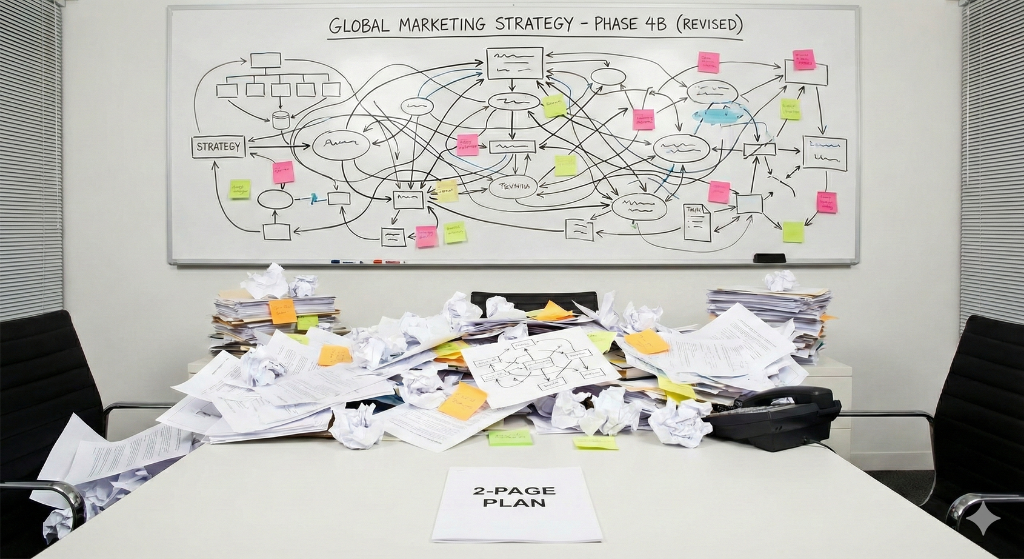
Where many businesses go wrong is assuming strategy has to be rigid to be effective. In reality, rigidity is often what causes strategy to fail.
A strategy that cannot flex will break the first time it hits resistance.
Another analogy we shared in the webinar was old wooden ships. They were not built to be stiff and unyielding. They were designed to flex and move with the sea. If they were rigid, they would crack the moment they hit a hard wave.
Marketing strategy needs that same balance.
It needs enough structure to give clarity and confidence. But enough flexibility to absorb change without collapsing.
This is especially important over long planning cycles. Most strategies are set annually. But very few years play out exactly as planned. New competitors enter the market. Economic conditions change. Weather, regulation, supply issues and consumer behaviour all shift.
If your strategy cannot adapt to those realities, it will be ignored.
At the same time, constant change without a fixed point leads to drift. Teams start chasing whatever looks urgent or interesting in the moment. Budget gets spread thinly. Focus disappears.
That is where the North Star matters.
If your core business goal is clear, it becomes much easier to make decisions. You can look at any proposed change and ask a simple question.
Does this move us closer to our core objective?
If the answer is yes, then adapting makes sense.
If the answer is no, then it is probably a distraction.
This applies at every level. Channels. Messaging. Budget allocation. Campaign objectives.
A channel performing better than expected does not mean abandoning the strategy. It means asking how that performance can support the same goal more effectively.
Equally, a channel underperforming does not automatically mean it should be cut. It might mean the approach needs to change.
The key is that adaptation feeds back into strategy, rather than replacing it.
One of the biggest mistakes we see is treating strategy as something that must be rewritten every time conditions change. Strategy should be stable enough that you recognise when you are drifting away from it.
If you find yourself constantly rewriting strategy documents, the issue is rarely the market. It is usually a lack of clarity at the top.
A strong marketing strategy gives you a reference point. Something to come back to when things feel uncertain. Something that allows you to say no as well as yes.
Because strategy is not just about what you do. It is about what you choose not to do.
If you are planning for the year ahead, focus less on predicting every change and more on setting a clear North Star. Get agreement on what success looks like. Make it visible. Make it hard to ignore.
Do that, and adaptation stops feeling like chaos. It becomes part of how the strategy works.

byEd
With roots on Lancashire dairy farms and a Master’s in Marketing specialising in AI, Ed combines hands-on agricultural experience with cutting-edge expertise. An AI expert with seven years in digital marketing, Ed has delivered results across PPC, SEO, email, and CRM for organisations like the LAMMA Show and Farmers Guardian.



Ready to Work Together?
 Get in touch


